Jasper Johns: Night Driver
OPENING TALK
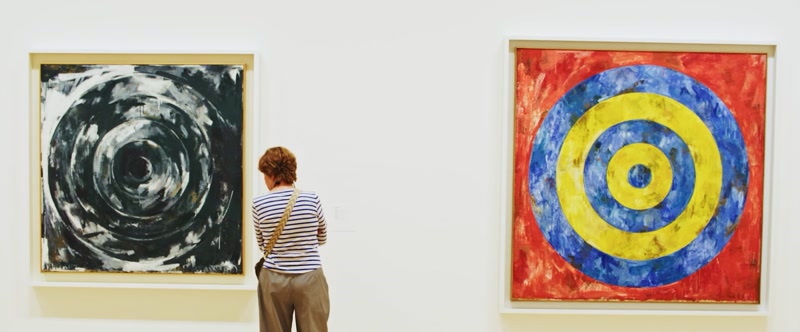
Jasper Johns: Night Driver 05.29.2026 - 10.12.2026 This retrospective exhibition dedicated to Jasper Johns spans the extensive career of one of the most celebrated artists of our time, from his early works made in the 1950s to some of his most recent pieces produced in the 2000s. The show highlights all the themes that define his production through a selection of pieces—mostly paintings, but also sculptures and a broad representation of his work on paper. Born in Augusta (Georgia, USA) in 1930, Jasper Johns was raised and educated in South Carolina and New York, to where he moved in 1953 and where he would soon meet influential figures like Robert Rauschenberg, composer John Cage, and choreographer Merce Cunningham; all four would have a profound impact on the New York art scene. In 1954–55 Johns painted his first American flag, a motif that prompted one of his most iconic series. Other familiar images were numbers, targets, and maps, whose ordinary, easily recognizable subject matter led them to be considered forerunners of Pop Art. Shown at Leo Castelli Gallery in 1958, they brought the artist immediate acclaim. During this time, Johns frequented Marcel Duchamp, whose work and ideas would have a decisive influence on him. Moving away from the rhetoric of Abstract Expressionism, Johns’s oeuvre, presented in series that explore the very nature of art, also anticipated Minimalism and Conceptual Art. Over the course of his career, Johns's works would include references to a wide range of artists—from Matthias Grünewald and Hans Holbein to John F. Peto, Edvard Munch, Paul Cézanne, Pablo Picasso, René Magritte, and Barnett Newman—along with direct quotes from authors like Hart Crane, Frank O’Hara, and Samuel Beckett. During the 1980s Johns looked to autobiography, including childhood memories and allusions to earlier pieces in new works. The new motifs added to his visual repertoire created dense compositions that weave hermetic narratives, although in the late 1990s his paintings pursued simplification. Johns has also created a vast and relevant corpus of works on paper, on view in two galleries of the exhibition. His prints and drawings are not preparatory studies but independent works that address themes that also run through his paintings and sculptures. Without overlooking its hedonistic or retinal qualities—its ability to capture the eye more than the mind—Johns’s art invites constant reflection. Curator: Enrique Juncosa Sponsored by: Fundación BBVA